Is It Safe to Upload Your Contract to ChatGPT?
 Written by Lóránt Bartha, Founder and CEO
Not as it stands, no.
A UK employment contract typically carries your full name, your home address, your salary, your start date, your line manager's name, your employer's registered office and often your National Insurance number. A service agreement usually adds a client name and project detail on top. Drop that file into ChatGPT from a personal account and you have handed a document full of identifiable information to a third party, in most cases with the training setting still switched on, because that is the default.
There is a version of the same document you can upload without any of that exposure. Replace every identifier with a plausible substitute and the clauses stay exactly as they are, which is the part you wanted reviewed in the first place. The names, the numbers and the addresses go.
This guide is the practical how-to: what to strip out, how to do it with free software that never sends your document anywhere, what anonymising genuinely protects you from, and the two problems it does not solve. We cover the wider question of whether ChatGPT can review a UK contract usefully at all separately.
Key Takeaways
On a personal ChatGPT account the default is that your conversations, including the files attached to them, can be used to improve OpenAI's models. You have to switch that off yourself under Data Controls.
Most employment contracts and service agreements contain a confidentiality clause, and disclosing the document to a third party can breach it whether or not your name is still on it.
Anonymising removes almost all of the data protection problem. It makes the confidentiality problem smaller, not absent, and it does nothing at all for accuracy.
LibreOffice Draw edits PDFs directly, runs offline and costs nothing, which is what makes it the practical tool for this job.
A general chatbot still will not apply UK employment law to what it reads, so a perfectly anonymised upload can still give you a confidently wrong answer.
What anonymising your contract actually means
The idea is simple. You remove every piece of personally identifiable information from the document before it goes anywhere near a general AI tool, and you are left with a realistic but fictional version of your contract.
The legal structure survives intact. Every clause keeps its wording, and the terms that matter (the notice period, the length of the restriction, the liability cap, the payment days) stay exactly as drafted. What disappears is the thread tying the document back to you, your employer or your client.
That split is the whole point. The clauses are what you want a second opinion on. The identifiers are the only part creating the exposure. There is no reason to upload both.
What to remove before you upload your contract
Work through the document and replace:
Personal details:
-
Your full name → "April Blues"
-
Home address → "123 Sample Street, Generic Town, GT1 2AB"
-
Phone number and email → "07700 900123" and "april.blues@email.com"
-
National Insurance number → "AB123456C"
Company information:
-
Company name → "BlueTech Solutions Ltd"
-
Office addresses → "456 Business Park, Example City, EC1 5XY"
-
Specific department names → "Digital Services" (instead of your actual department)
-
Manager names → "Sam Carter"
Business-specific details:
-
Specific project names → "Project Phoenix" (instead of actual project names)
-
Client names → "MegaCorp Industries"
-
Proprietary systems or software → "CompanyFlow System"
Example: Instead of "Sarah Jones will report to Marketing Director Michael Brown at TechCorp's London office", write "April Blues will report to Marketing Director Sam Carter at BlueTech Solutions' Manchester office."
Salary is the awkward one, because it is personal data and it is also a term you probably want checked. Round it, do not delete it. If you are on £48,400, make it £50,000. The clause still reads sensibly, any calculation built on it still makes sense, and the figure no longer belongs to a real person on a real payroll.
If all you want to know is how the salary compares with the market, you do not need to paste it anywhere: our free salary checker shows official ONS pay figures from the job title alone.
Two things people miss. The first is dates: a start date combined with a job title and a town is often enough to identify someone, so shift them by a few weeks if the exact date is not material to the clause you are asking about. The second is the file name itself, which is frequently something like "J-Smith-TechCorp-contract-signed.pdf" and travels with the upload.
How to anonymise a PDF contract with LibreOffice Draw
We recommend LibreOffice Draw for this job. It is free, it works offline (so your original document never touches the internet), and it has a straightforward find-and-replace feature that keeps the work mechanical, not fiddly. Most importantly, it edits PDF files directly, which is how most employment contracts and service agreements are sent.
Here's how to do it:
📌 Step 1: Download LibreOffice and open your PDF contract directly in LibreOffice Draw
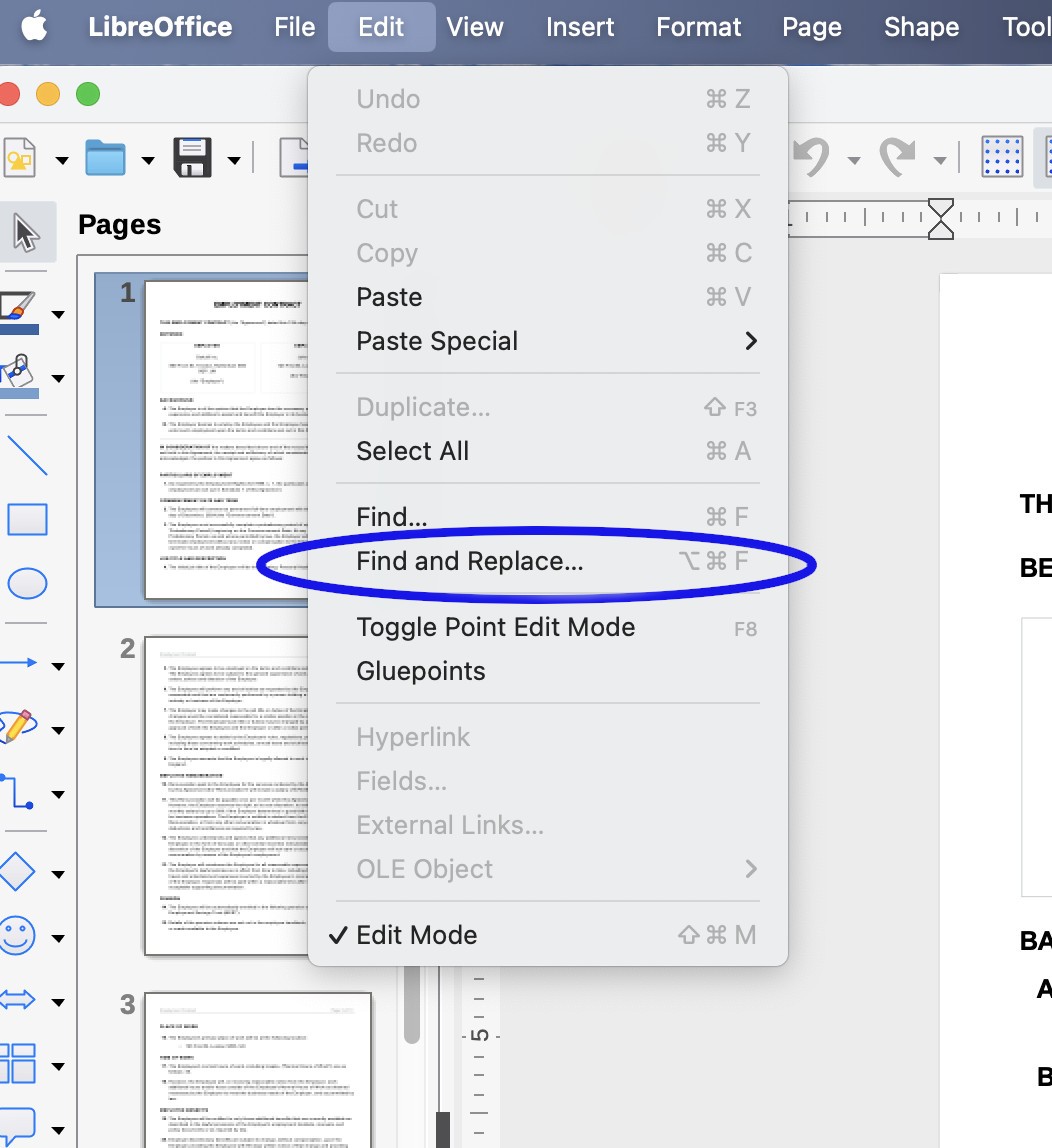
📌 Step 2: Open find-and-replace (Cmd+Alt+F on Mac, Ctrl+H on Windows and Linux, or Edit then Find & Replace from the menu bar)
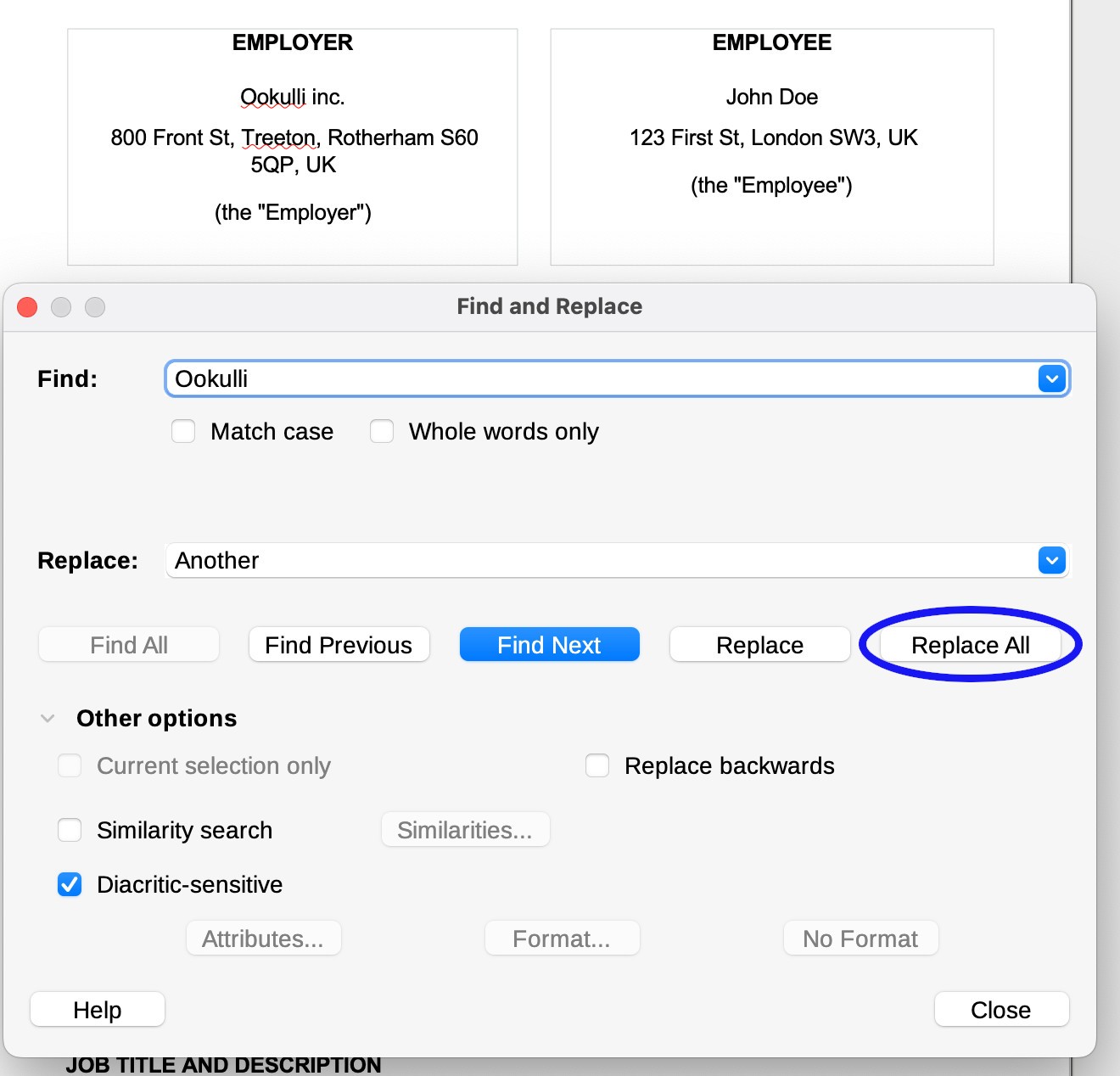
📌 Step 3: Work through each identifier systematically:
-
Find: "Sarah Jones" → Replace: "April Blues"
-
Find: "TechCorp Limited" → Replace: "BlueTech Solutions Ltd"
-
Find: "Michael Brown" → Replace: "Sam Carter"
-
Find: "London office" → Replace: "Manchester office"
📌 Step 4: Clear the document properties. File → Properties → General: untick Apply user data, then click Reset Properties. Resetting alone does not hold — LibreOffice writes your name back on export. PDFs carry hidden metadata (author, company, the application that produced it) that find-and-replace never touches.
📌 Step 5: Export the result as a new PDF (File, then Export as PDF) instead of saving it as a LibreOffice drawing, and give it a clean, boring file name like "Contract_Anonymised_AprilBlues"
📌 Step 6: Upload only the anonymised version to your AI tool
💡 Pro Tip: Read the document through once after the find-and-replace, on screen, before you upload anything. Find-and-replace is literal. Search for "Sarah Jones" and every stray "Sarah" survives untouched, along with the initials in a signature block. Anything sitting in a header, a footer, a logo or a scanned image is not live text at all, so it never gets looked at.
If any part of your contract is a scanned image, not selectable text, find-and-replace cannot see it at all. Check by trying to select a line of text with your cursor. If nothing highlights, that page is a picture, and you will need to cover the identifiers with filled rectangles in Draw instead.
What anonymising protects you from
Confidentiality exposure. You are no longer disclosing whose agreement this is, which makes it considerably harder to argue that showing the document to a third party identified anyone or damaged anyone's interests.
Data protection exposure. If the AI provider stores the document, or uses it to train a future model, there is no personal data in it to be stored or trained on. The question of lawful basis and international transfers largely falls away, because there is nothing left to transfer.
Your employer's and your client's information. This is the one people underrate. Your contract does not only contain your data. It contains your manager's name, your employer's terms, and sometimes a client's project details that you were separately obliged to protect. Anonymising takes all of that out of the equation too.
What anonymising does not fix
Anonymising is a real improvement. It is not a clean bill of health, and there are two gaps worth being straight about.
🔹 The confidentiality clause usually protects the terms, not just the names. A typical clause restricts disclosure of "the terms of this agreement" to a short list of permitted recipients, normally your legal adviser, your accountant and your spouse. Stripping out the names means you are no longer disclosing whose terms these are, but you are still disclosing the terms. That is a reduction in risk, not an exemption, and it matters most when the document belongs to a client and not to you.
🔹 You are still asking a general chatbot a UK law question. Anonymising changes what the tool receives. It does not change what the tool knows. A generic model will still read a defined term by its everyday meaning rather than the definition set out in clause 1, still miss the risk that only appears when two clauses are read together, and still apply whichever jurisdiction's assumptions dominate its training data. That is a separate failure mode, and it is covered in full in why generic AI gets contract review wrong.
There are two practical limitations on top of those. Thorough anonymisation takes attention to detail, and the burden of being thorough sits entirely with you. And the AI provider's own privacy policy still governs whatever you send, anonymised or not.
The safer option: a tool built to take the real contract
The reason a purpose-built tool exists is that the whole find-and-replace exercise is a workaround for a general chatbot that was never designed to receive legal documents.
Ookulli was built for this specific job, which changes three things:
Your documents are never used for AI training. There is no setting to find and no default working against you, so there is nothing to anonymise before you upload.
The analysis is UK-specific and clause by clause. Ookulli reviews employment contracts, service agreements and NDAs against UK employment and contract law, rather than summarising them against general legal knowledge.
Every flag shows its source. Each highlight names the clause it refers to and the UK law it has been cross-referenced against, so you can check the reasoning instead of taking an AI's word for it. That is the difference between a confident answer and a verifiable one.
Should you use ChatGPT for this at all?
If you are set on using a general AI tool, anonymise first. The method above turns a genuinely risky habit into a reasonable one, and it takes one pass through the document.
But it is worth asking what the workaround is buying you. You spend the time stripping identifiers. You accept a confidentiality question that is reduced but not resolved. What you get at the end is a generic summary from a tool that does not know UK employment law. If you are going to that much trouble to stay safe, a tool that was built for the job skips the anonymising entirely and gives you a better answer at the end.
Frequently asked questions
Should I anonymise, or not upload at all?
Anonymise if you are going to upload: it takes one pass and removes almost all of the exposure. Whether to upload in the first place turns on confidentiality, UK GDPR and whether a general model can read a UK contract accurately, and we answer that in can I use AI to review my contract?.
Does ChatGPT train on the documents I upload?
On the consumer plans, yes, unless you change the setting. OpenAI's free and Plus tiers use your conversations, including the files attached to them, to improve their models by default, and you switch it off under Settings, then Data Controls. Business products such as Team, Enterprise and API access do not use your data for training by default, but those are not the plans most people reviewing a single contract are on. The important detail is that this is opt-out, not opt-in, so doing nothing leaves it on.
What should I remove from a contract before uploading it?
Everything that identifies a person, a company or a piece of work: your name, home address, phone number, email, National Insurance number, your manager's name, the employer's name and registered office, department names, client names, project names and any internal system names. Do not delete your salary; round it to a nearby figure so the clause still reads sensibly. Then check the places find-and-replace does not reach: headers, footers, signature blocks, scanned pages, the document properties and the file name itself.
Before you upload anything
Your contract is one of the few documents that can decide where you work next, what you are paid and what happens if the relationship ends badly. It deserves a proper read, and it deserves not to be leaked in the process of getting one.
If you want to use a general AI tool, strip the identifiers first with the method above, and go in knowing what you are still exposed to. If you would rather not run that gauntlet at all, review your first contract free with Ookulli, then from £10 per document, with a 30-day money-back guarantee. Your document stays private, it is never used for training, and the analysis is grounded in UK law.
This article is general information about UK contracts and data protection. It is not legal advice. If you have a specific concern about your contract, consider speaking to a qualified solicitor.


