How to negotiate an NDA in the UK (without losing the work)
 Written by Lóránt Bartha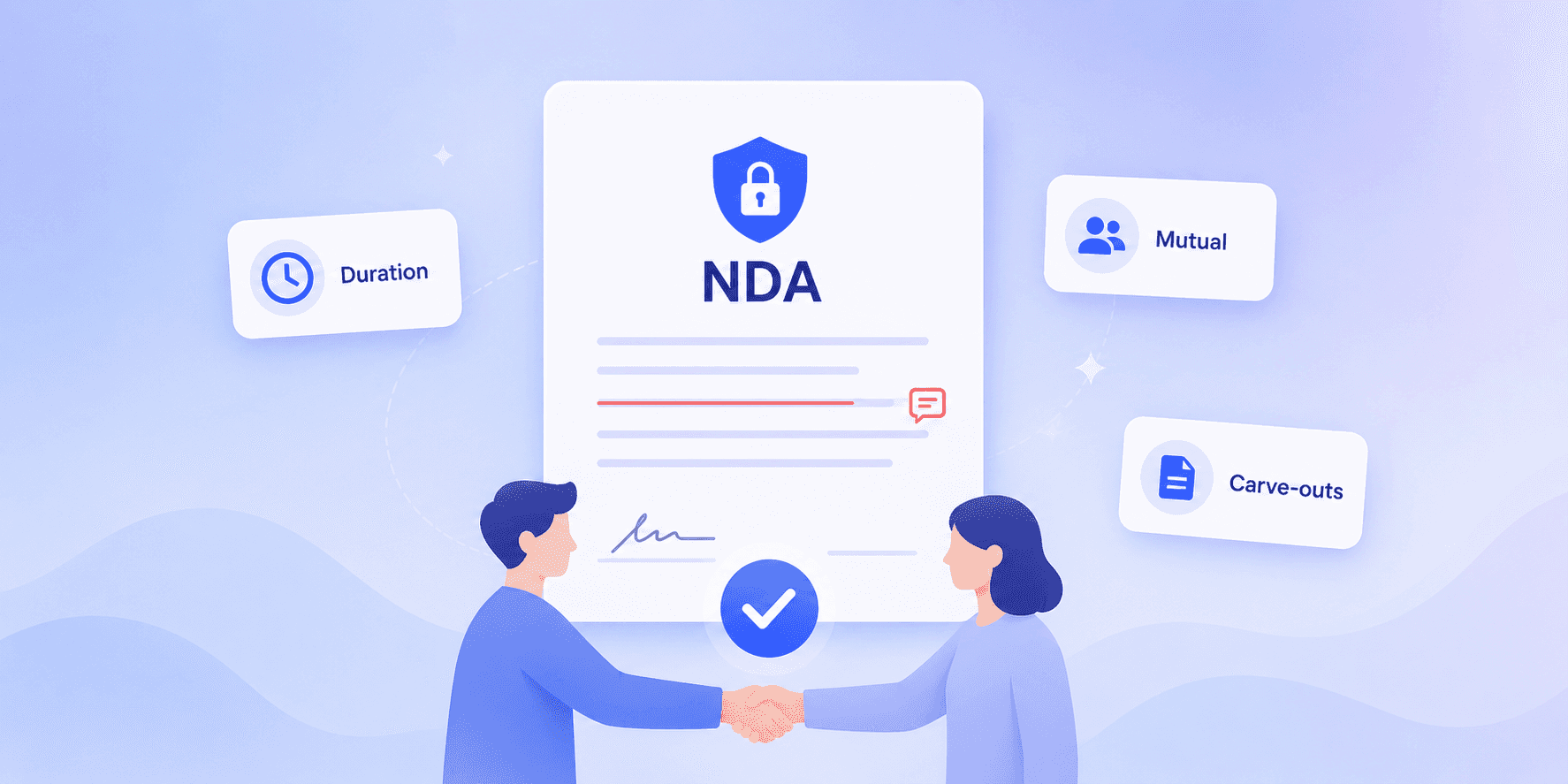
Yes, you can negotiate an NDA. Most UK freelancers sign whatever they are handed, but NDAs are contracts like any other, and the recipient can and should push back on five things: how long confidentiality lasts, how "confidential information" is defined, whether the obligations are one-way or mutual, what carve-outs are included, and any restrictions that creep beyond confidentiality. Clients expect occasional pushback on these points. Asking for reasonable changes reads as professional, not difficult.
This guide covers the clauses actually worth negotiating, what standard looks like for each, and the exact wording to use when you ask.
Key Takeaways
NDAs are negotiable, and pushing back on a small number of specific clauses is normal professional behaviour in the UK
The five clauses worth your attention: duration, the definition of confidential information, one-way vs mutual obligations, carve-outs, and restrictive creep
The most common problem is an overbroad definition of "confidential information" that captures everything the client ever tells you
Ask for changes in writing, propose specific replacement wording, and frame each request around making the agreement workable, not around distrust
Walk away signals: a client who refuses every carve-out, insists on indefinite confidentiality for ordinary project information, or hides non-compete terms inside an NDA
Can you actually negotiate an NDA?
Legally, an NDA is just a contract. Nothing in UK law makes it a take-it-or-leave-it document, and the government's own guidance on non-disclosure agreements is clear that they cannot override your legal rights regardless of what you sign.
In practice, most NDAs handed to freelancers were not written for you. They are templates, often drafted years ago for a different purpose, sometimes for employees rather than contractors. The person sending it frequently has not read it recently. That is exactly why polite, specific pushback works: you are usually the first person to engage with the actual text, and a reasonable client would rather adjust two clauses than lose a good freelancer over boilerplate.
When Dan, a freelance data consultant, was handed an NDA by a Manchester logistics firm in 2025, it demanded indefinite confidentiality over "all information disclosed in any form". He replied with one sentence: could we cap confidentiality at three years, except for genuine trade secrets? The client's operations director agreed the same afternoon and mentioned that nobody had ever asked. The work went ahead on schedule.
Before you negotiate anything, though, you need to know what the NDA actually says. Run it through a structured review first, or upload it to Ookulli's NDA review and see every risky clause flagged against UK law in minutes, first contract free.
The five clauses worth negotiating
You will not get, and should not ask for, twenty changes. Focus on the clauses that carry real risk. If the document is a mess from top to bottom, it can be easier to propose your own instead: our guide to NDA templates for freelancers covers what a clean one contains.
1. Duration of confidentiality
What is standard: two to five years for ordinary business information. Genuine trade secrets can justifiably be protected indefinitely, but most project information is not a trade secret.
What to ask for: a fixed term. "Could we cap the confidentiality obligations at three years from disclosure, except for information that qualifies as a trade secret?"
An NDA with no end date means you carry the compliance burden forever, for a project that might last six weeks. We cover what is reasonable by document type in our guide to how long an NDA lasts in the UK.
2. The definition of "confidential information"
This is the most common problem in freelancer NDAs. An overbroad definition captures everything the client ever tells you, including things you already knew, information that is publicly available, and general skills and experience you build on the project. It also makes an accidental breach far more likely, and what happens if you breach an NDA is worth understanding before you sign.
What is standard: a definition limited to information that is identified as confidential, or that a reasonable person would understand to be confidential, disclosed in connection with the specific project.
What to ask for: "Could we tighten the definition to information disclosed in connection with this project that is marked confidential or would reasonably be understood as confidential?"
3. One-way or mutual obligations
Most freelancers are handed a one-way NDA: all the obligations sit on you, none on the client. That is sometimes fine. If you will be sharing your own methods, pricing, tools or pre-existing IP, it is not.
What to ask for: "Since I'll also be sharing my own working methods and materials, could we make the confidentiality obligations mutual?"
The difference matters more than most people realise. We break it down in mutual vs one-way NDAs for UK freelancers.
4. Standard carve-outs
A properly drafted NDA always excludes certain information from confidentiality. If these carve-outs are missing, that is a drafting failure you should fix, not a negotiation favour you are asking for.
The standard four:
-
Information already in the public domain (other than through your breach)
-
Information you already held before disclosure
-
Information you develop independently
-
Information you are legally required to disclose (a court order, a regulator, HMRC)
What to ask for: "The agreement seems to be missing the standard exclusions. Could we add carve-outs for public domain information, prior knowledge, independent development and legally required disclosure?"
The legally-required-disclosure carve-out has extra weight in the UK. The Solicitors Regulation Authority's guidance on NDAs exists precisely because NDAs were being drafted to suggest people could not report wrongdoing to regulators. They cannot, and an NDA that implies otherwise is a serious red flag.
5. Restrictive creep: non-solicit and non-compete terms
An NDA should protect information. Some quietly do more: a clause stopping you working with the client's competitors, or soliciting their customers or staff, is a restrictive covenant hiding inside a confidentiality agreement.
What to ask for: removal, or at minimum a tight scope and short duration. "Clause 7 goes beyond confidentiality into restricting who I can work for. As a freelancer working across this sector, I can't accept a non-compete, though I'm happy to commit to not using your confidential information for any other client."
Whether those clauses are even enforceable against you is its own question, covered in can an NDA stop you working for competitors in the UK?
One more to check rather than negotiate: governing law. For a UK freelancer working with a UK client, the agreement should be governed by the law of England and Wales (or Scotland), with the courts of that jurisdiction. If a UK client's NDA specifies Delaware law, query it; it is usually a sign of an unedited US template.
How to ask without losing the work
The fear that negotiating will cost you the project is the main reason freelancers sign bad NDAs. In practice, the way you ask matters far more than the fact that you asked.
Put it in writing, briefly. Email beats a call: it gives the client something to forward to whoever owns the template, and it keeps your tone even.
Propose wording, don't just object. "This clause is too broad" creates work for the client. "Could we replace this with X?" lets them say yes in one reply.
Frame it around workability, not distrust. You are not accusing anyone of bad faith; you are making sure you can comply with what you sign.
A script that covers most situations:
"Thanks for sending the NDA over. I'm happy to sign, with two small adjustments so I can genuinely comply: could we cap confidentiality at three years (except trade secrets), and add the standard carve-outs for public domain and independently developed information? I've suggested wording below. Happy to get started as soon as this is sorted."
Two changes, specific wording, a clear signal you want the work. That is the whole technique. If the contract attached to the NDA needs the same treatment, the same approach works there too: see how to negotiate a freelance contract in the UK.
Know what you're asking for before you ask. Ookulli reviews your NDA — first contract free, then £10 per document, flags the clauses that need changing, and explains the UK law behind each flag, so your email asks for the right things with confidence. No subscription, your document is never used to train AI, and a 30-day money-back guarantee.
When to walk away
Most NDA negotiations end in agreement. Occasionally they reveal a client you do not want.
Consider walking away when:
-
Every carve-out is refused. A client who will not exclude public domain information is asking you to carry impossible obligations.
-
Indefinite confidentiality for ordinary information is non-negotiable. Perpetual terms are for trade secrets, not project briefs.
-
A non-compete is buried in the NDA and they insist on keeping it. That is not confidentiality; that is restricting your livelihood before the relationship has even started.
-
The NDA suggests you cannot speak to regulators or report wrongdoing. Under UK law it cannot stop you — ACAS guidance is explicit, and since October 2025 the Victims and Prisoners Act 2024 voids any clause that would stop a victim of crime reporting it — but a client who drafts that way is showing you something.
A client's behaviour over an NDA is a preview of their behaviour over invoices, scope and disputes. Sarah, a freelance copywriter in Bristol, walked away from a retainer in 2026 after the client refused to remove a clause claiming confidentiality over "the existence of this agreement and any dissatisfaction with our services". Six months later the client was publicly named by three other freelancers for late payment. The NDA told her first.
Negotiate from knowledge, not nerves
NDAs are negotiable, and the freelancers who negotiate them well share one habit: they know exactly what the document says before they reply. Read it properly, identify which of the five clauses need work, ask for specific changes in writing, and stay warm and brief.
Upload your NDA to Ookulli and get every risky clause flagged in plain English, with the specific UK law behind each flag. First contract free, then £10 per document, with a 30-day money-back guarantee. Sign with confidence, or negotiate from a position of knowledge.
FAQ
Can you negotiate an NDA?
Yes. An NDA is a contract, and either party can propose changes before signing. For freelancers, the most commonly negotiated points are the duration of confidentiality, the definition of confidential information, mutual vs one-way obligations, missing carve-outs, and any non-compete or non-solicit terms that go beyond confidentiality.
Should you sign an NDA without changes?
Only if it is already reasonable: a fixed duration (typically 2 to 5 years), a tight definition of confidential information, the four standard carve-outs, and no restrictions beyond confidentiality. If any of those are missing, ask for changes before signing. Most clients agree to reasonable requests.
What can you ask to remove from an NDA?
The most common removals are non-compete and non-solicit clauses (which restrict your work rather than protect information), indefinite confidentiality for ordinary business information, and clauses suggesting you cannot make legally required or protected disclosures. You can also ask to narrow an overbroad definition of confidential information rather than remove it.
Will negotiating an NDA make me look difficult?
No. Specific, polite requests with proposed wording read as professional diligence. Clients deal with redlines from suppliers and partners routinely; a freelancer who engages with the text signals that they take confidentiality seriously, which is exactly what an NDA is for.
Informational purposes only, not legal advice. For your situation, consult a qualified solicitor.