Mutual vs one-way NDA: which should a UK freelancer sign?
 Written by Lóránt Bartha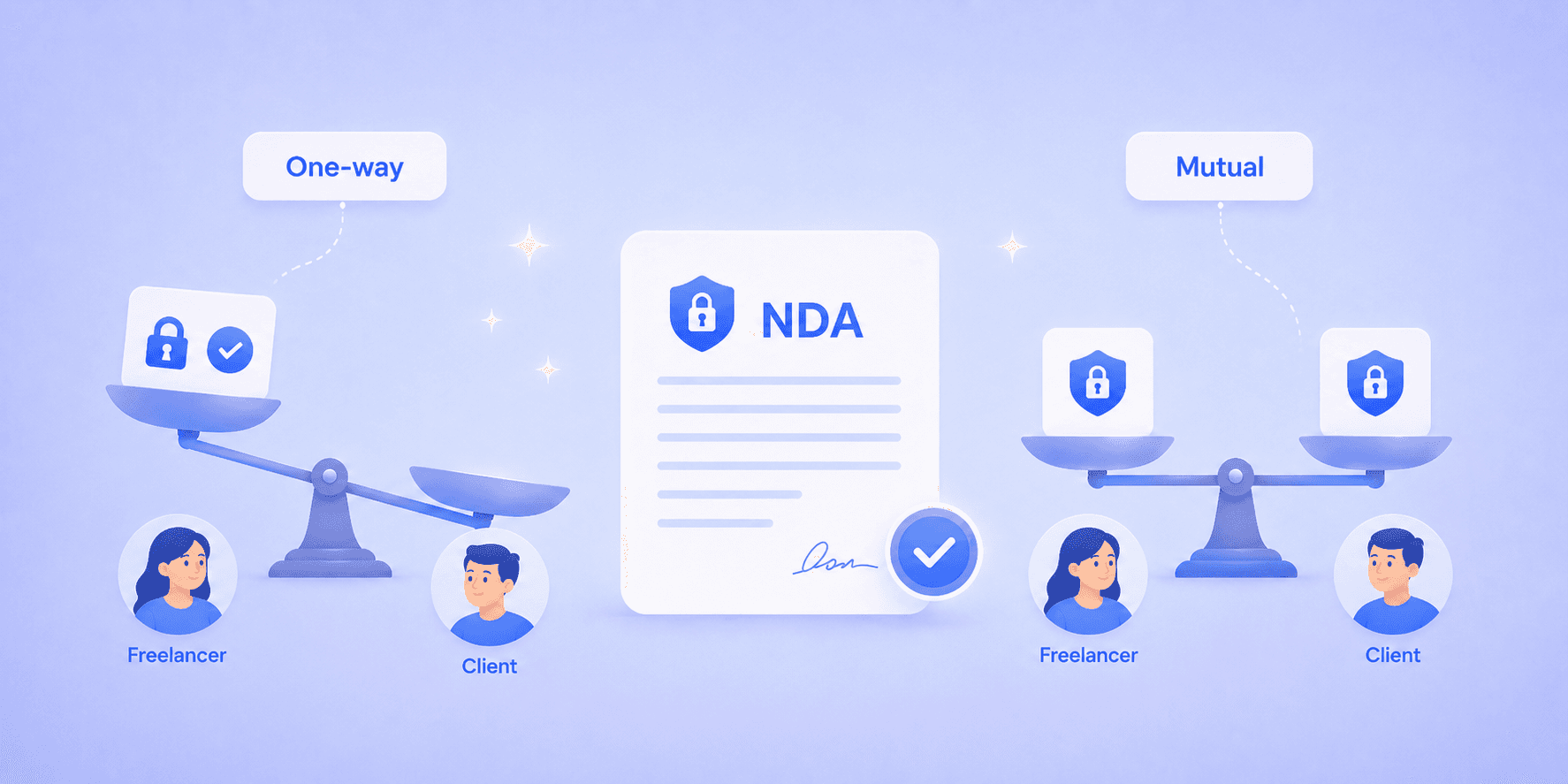
A one-way (unilateral) NDA binds only one party to confidentiality, and as a freelancer that party is almost always you. A mutual (bilateral) NDA binds both sides. Most NDAs handed to UK freelancers are one-way, which means every obligation, every risk and every potential breach claim sits on you and none on the client. That is sometimes appropriate. If you will be sharing anything of your own, your methods, your pricing structures, your pre-existing work, it is not, and asking to make the NDA mutual is a normal, low-friction request.
Here is how to tell which type you have been handed, what the difference means in practice, and when to ask for mutual terms. For the wider picture, our explainer on what a non-disclosure agreement is sets out what signing one commits you to.
Key Takeaways
One-way NDAs bind only the recipient (usually the freelancer); mutual NDAs bind both parties to the same confidentiality obligations
Freelancers are almost always handed one-way NDAs, which concentrates all legal risk on the person with the least bargaining power and no legal team
A one-way NDA is fair when the information genuinely flows in one direction; it stops being fair the moment you share your own methods, rates or materials
You can identify the type in under a minute: look at who is defined as "Discloser" and "Recipient", and whether obligations apply to "each party" or only to you
Converting to mutual is usually a one-line request that clients accept readily, because it costs them nothing they were not already asking of you
One-way vs mutual: the plain-English difference
A one-way NDA has a discloser and a recipient. The client (discloser) shares confidential information; you (recipient) promise not to use or reveal it. Your obligations are enforceable against you. The client promises nothing about anything you share.
Example: a Birmingham fintech hires Tom, a freelance UX researcher, to interview their users about an unreleased feature. The information flows entirely from client to freelancer. Tom learns their roadmap; they learn nothing of his beyond his invoice. A one-way NDA fits this engagement honestly.
A mutual NDA defines both parties as potential disclosers and binds both to the same obligations. Whatever you share with them is protected on the same terms as whatever they share with you.
Example: Aisha, a freelance growth consultant, brings her own benchmarking dataset, channel playbooks and pricing models into a client engagement. The client sees her materials in every workshop. If her NDA is one-way, nothing in it protects her side, and she would have no remedy under the agreement if the client reuses or shares her work.
The test is simple: does information genuinely flow in one direction, or both? Be honest about your own side. Most experienced freelancers share more proprietary method than they realise.
Why the difference matters more for freelancers
The asymmetry of a one-way NDA is not just conceptual. It shapes real risk in three ways.
All the compliance burden is yours. You are the one who must track what was confidential, store documents safely, and remember the obligations for the full term of the agreement (and NDA durations can run for years).
All the litigation exposure is yours. Only one party can be sued under a one-way NDA, and it is you. The client carries zero reciprocal risk, which is also why one-way templates tend to be drafted aggressively: nothing in the document costs its author anything.
Your side has no protection by default. Without mutual terms, nothing in the agreement stops a client circulating your proposal, your rates or your process documentation. For freelancers whose methods are their product, that is a genuine commercial loss waiting to happen.
None of this makes one-way NDAs wrong. It makes them precise instruments that are only fair when they match the actual flow of information. The problem is that they get used as the default for everything.
First step before any of this: know which one you have. Upload your NDA to Ookulli and it will tell you in plain English whether the obligations are one-way or mutual, what they cover, and which clauses need attention. Your first review is free.
How to tell which type you have been handed
You can usually identify the type in under a minute:
-
Check the parties paragraph. If it defines one party as "Discloser" and the other as "Recipient", it is one-way. If it says "each party may disclose", it is mutual.
-
Scan the obligations clause. "The Recipient shall..." is one-way drafting. "Each party shall..." is mutual drafting.
-
Check the definitions. If "Confidential Information" means only information disclosed by the company, the protection only runs one way, whatever the rest of the document implies.
Watch for the hybrid trap: some NDAs use mutual-sounding language in the recitals but define confidential information as the client's information only. The definitions clause wins. This is exactly the kind of drafting detail covered in how to review an NDA in the UK.
When to accept one-way, and when to ask for mutual
One-way is reasonable when:
-
The engagement genuinely only exposes you to their information (user research, an audit of their systems, due diligence on their business)
-
You bring standard skills rather than proprietary materials
-
The NDA is otherwise clean: sensible duration, tight definition, standard carve-outs
Ask for mutual when:
-
You will share your own methodologies, templates, datasets or tools
-
Your pricing, pipeline or client list will be visible to them
-
You are pitching: a proposal contains your thinking, and a one-way NDA protects their brief but not your ideas
-
The collaboration is genuinely two-way (co-developing a product, white-labelling your service)
The ask itself is one sentence: "Since I'll also be sharing my own methods and materials during this project, could we make the confidentiality obligations mutual? Happy to sign today with that change." Clients rarely resist, because mutual terms simply extend to them the standard they were already asking of you. If you would rather start from a fair baseline than repair theirs, our guide to freelancer NDA templates covers what to include when you send your own.
Red flags in one-way NDAs aimed at freelancers
One-way NDAs are where aggressive boilerplate concentrates, because nothing in the document constrains its author. When you receive one, check for the usual suspects:
-
An overbroad definition of confidential information ("all information disclosed in any form") that captures your general skills and experience
-
Indefinite duration applied to ordinary project information rather than genuine trade secrets
-
Restrictive creep: non-compete or non-solicit clauses hiding inside a confidentiality agreement
-
No carve-outs for public domain information, prior knowledge, independent development or legally required disclosure
-
Implied total silence: any suggestion you cannot speak to regulators or report wrongdoing, which no UK NDA can lawfully impose — government guidance and ACAS are explicit, and since October 2025 the Victims and Prisoners Act 2024 voids any clause that would stop a victim of crime reporting it
Any of these is worth a redline regardless of whether the NDA is one-way or mutual; together with one-way obligations, they stack all the risk on your side of the table. And if the NDA arrives bundled with a service agreement, review the whole package together: the UK freelancer's guide to reviewing any contract covers the rest.
Thirty seconds from now you could know exactly what you're signing. Ookulli reviews your NDA — first contract free, then £10 per document: one-way or mutual, every risky clause flagged, and the specific UK law behind each flag. No subscription, no AI training on your documents, and a 30-day money-back guarantee.
FAQ
Is a one-way or mutual NDA better?
Neither is inherently better; they fit different situations. A one-way NDA is appropriate when information genuinely flows in one direction. A mutual NDA is better whenever both sides share anything sensitive, which for freelancers with their own methods, pricing and materials is most real engagements. The wrong choice is signing a one-way NDA in a two-way situation.
What is a unilateral NDA?
A unilateral (one-way) NDA is a confidentiality agreement in which only one party, the recipient, takes on obligations. The discloser shares information; the recipient promises not to use or reveal it. In freelance engagements, the freelancer is almost always the recipient, carrying all the obligations and all the legal exposure.
Should a freelancer sign a one-way NDA?
Yes, when the engagement genuinely only exposes the freelancer to the client's information and the NDA is otherwise reasonable: a sensible duration, a tight definition of confidential information, and standard carve-outs. If you will be sharing your own methods, rates or materials, ask to make it mutual first; it is a one-line change that most clients accept without friction.
What is a bilateral NDA in the UK?
A bilateral NDA is the same thing as a mutual NDA: both parties are bound by identical confidentiality obligations under UK law. The terms "mutual", "bilateral" and "two-way" are used interchangeably in practice. The legal framework is ordinary contract law; there is no separate statute governing NDA types in the UK.
Informational purposes only, not legal advice. For your situation, consult a qualified solicitor.